
Bandingkan overhead cranes dan gantry cranes untuk bisnis Anda. Pelajari kelebihan, kekurangan, dan aplikasi terbaik masing-masing sistem crane untuk efisiensi maksimal.
Pemilihan antara overhead cranes dan gantry cranes bergantung pada struktur bangunan, ruang kerja, dan kebutuhan operasional spesifik bisnis Anda. Overhead cranes lebih cocok untuk fasilitas indoor dengan struktur bangunan yang kuat, menawarkan jangkauan maksimal dan efisiensi ruang lantai. Gantry cranes ideal untuk area outdoor atau fasilitas dengan keterbatasan struktur atap, memberikan fleksibilitas instalasi dengan kaki penyangga mandiri yang dapat dipindahkan sesuai kebutuhan.
Kedua jenis crane ini memiliki karakteristik unik yang menentukan efektivitas penggunaannya dalam berbagai industri. Memahami perbedaan fundamental antara overhead cranes dan gantry cranes akan membantu Anda membuat keputusan investasi yang tepat untuk meningkatkan produktivitas dan efisiensi operasional.
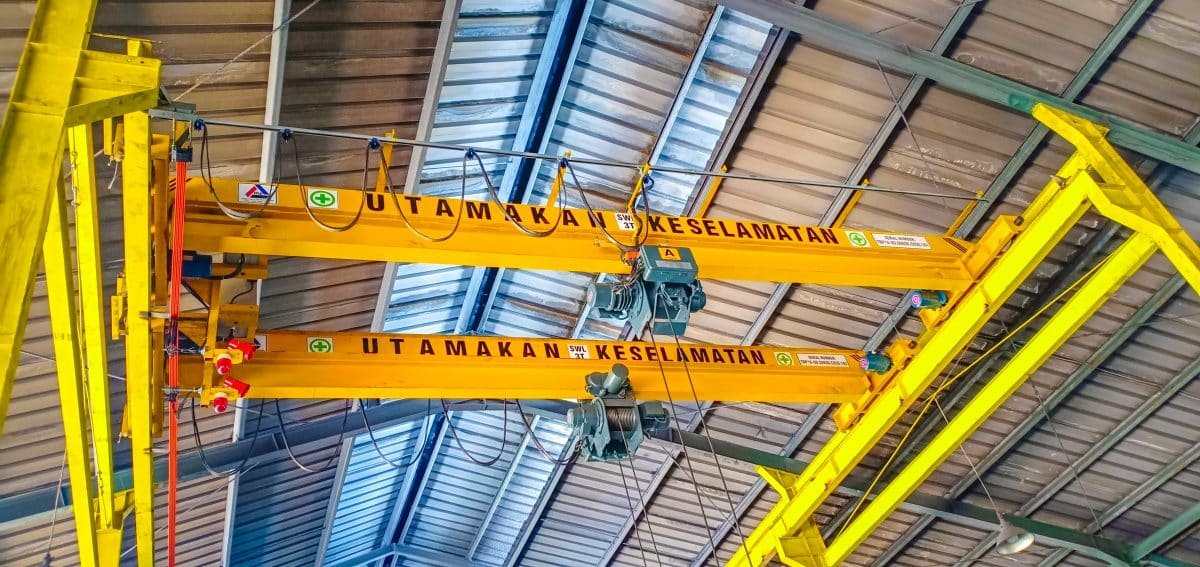
Overhead cranes merupakan sistem pengangkat yang dipasang pada struktur atap bangunan menggunakan runway beam yang terpasang pada kolom atau dinding. Bridge crane bergerak sepanjang runway dengan trolley yang melintasi bridge, menciptakan area kerja persegi panjang dengan jangkauan maksimal tanpa hambatan di lantai produksi.
Sistem ini memanfaatkan struktur bangunan eksisting sebagai titik tumpuan utama, sehingga memerlukan evaluasi struktural yang mendalam sebelum instalasi. Kapasitas angkat overhead cranes dapat mencapai ratusan ton dengan span hingga 40 meter atau lebih.
Gantry cranes menggunakan kaki penyangga atau portal frame sebagai struktur pendukung bridge, memungkinkan operasi tanpa ketergantungan pada struktur bangunan. Sistem ini bergerak di atas rel lantai dengan fleksibilitas perpindahan lokasi sesuai kebutuhan proyek.
Desain gantry cranes memberikan kebebasan instalasi di area terbuka seperti shipyard, container yard, atau fasilitas outdoor lainnya. Variasi desain mencakup full gantry dengan dua kaki penyangga, semi gantry dengan satu kaki penyangga, dan portable gantry untuk aplikasi fleksibel.
PT Triniti Bangunindo Perkasa adalah penyedia overhead cranes dan gantry cranes berkualitas tinggi yang memahami kebutuhan spesifik berbagai industri di Indonesia. Tim ahli perusahaan siap memberikan konsultasi untuk menentukan pilihan terbaik.
Overhead cranes mengandalkan struktur bangunan sebagai titik tumpuan, memerlukan kolom dan balok atap yang mampu menahan beban kerja dan beban mati crane. Perhitungan struktural harus mempertimbangkan defleksi maksimal dan fatigue loading untuk memastikan keamanan jangka panjang.
Gantry cranes menggunakan struktur mandiri dengan fondasi khusus untuk setiap kaki penyangga. Desain ini memberikan fleksibilitas tetapi memerlukan area lantai yang cukup untuk pergerakan kaki crane dan clearance yang memadai.
Overhead cranes menawarkan jangkauan area kerja yang maksimal karena tidak ada penghalang di lantai produksi. Hook dapat menjangkau hampir seluruh area di bawah runway dengan pembatasan minimal dari struktur pendukung.
Gantry cranes memiliki keterbatasan jangkauan karena adanya kaki penyangga yang membatasi akses. Namun, sistem ini dapat beroperasi di area yang lebih luas dengan perpindahan seluruh unit crane sesuai kebutuhan.
Kedua sistem dapat menangani kapasitas angkat yang sama, mulai dari beberapa ton hingga ratusan ton. Perbedaan utama terletak pada distribusi beban dan cara transfer beban ke struktur pendukung atau fondasi.
| Comparison Criteria | Overhead Cranes | Gantry Cranes | Winner | Key Considerations |
|---|---|---|---|---|
| Structural Requirements | ||||
| Building Structure Needed | Strong roof structure, runway beams | Minimal building structure | Gantry | Building dependency |
| Foundation Requirements | Building column reinforcement | Ground rail foundations | Gantry | Foundation complexity |
| Structural Independence | Dependent on building | Self-supporting structure | Gantry | Installation flexibility |
| Installation Factors | ||||
| Installation Complexity | High (structural modifications) | Medium (foundation + rails) | Gantry | Implementation ease |
| Installation Time | 4-8 weeks | 2-4 weeks | Gantry | Project timeline |
| Downtime During Installation | High (building modifications) | Low (minimal disruption) | Gantry | Business continuity |
| Operational Performance | ||||
| Floor Space Utilization | 95-100% (no obstructions) | 70-85% (legs obstruct) | Overhead | Space efficiency |
| Working Area Coverage | Complete rectangular area | Limited by leg positions | Overhead | Coverage completeness |
| Hook Approach Distance | Minimal (close to walls) | Limited by leg clearance | Overhead | Precision access |
| Maximum Span Capability | Up to 40+ meters | Up to 35 meters | Overhead | Large area coverage |
| Capacity & Performance | ||||
| Weight Capacity | 1-500+ tons | 1-500+ tons | Tie | Equal capabilities |
| Lifting Height | Building height dependent | Full height available | Tie | Height flexibility |
| Speed & Precision | High precision, variable speed | High precision, variable speed | Tie | Performance equality |
| Environmental Suitability | ||||
| Indoor Applications | Excellent | Good | Overhead | Controlled environment |
| Outdoor Applications | Not suitable (building required) | Excellent | Gantry | Weather exposure |
| Weather Resistance | Protected by building | Requires weather protection | Overhead | Environmental protection |
| Mobility/Relocation | Fixed installation | Can be relocated | Gantry | Flexibility needs |
| Cost Analysis | ||||
| Initial Equipment Cost | Rp 800 juta – 5 miliar | Rp 500 juta – 3 miliar | Gantry | Equipment investment |
| Installation Cost | Rp 400 juta – 2 miliar | Rp 200 – 800 juta | Gantry | Implementation cost |
| Infrastructure Cost | Rp 200 juta – 1 miliar | Rp 100 – 500 juta | Gantry | Supporting infrastructure |
| Total Initial Investment | Rp 1.4 – 8 miliar | Rp 800 juta – 4.3 miliar | Gantry | Upfront cost |
| Operating Costs | ||||
| Energy Consumption | Lower (no leg movement) | Higher (moving structure) | Overhead | Operational efficiency |
| Maintenance Cost | Lower (protected environment) | Higher (weather exposure) | Overhead | Lifecycle maintenance |
| Annual Operating Cost | 3-5% of investment | 4-7% of investment | Overhead | Ongoing expenses |
| Flexibility & Adaptability | ||||
| Layout Modification | Difficult (structural changes) | Easy (relocatable) | Gantry | Change adaptability |
| Capacity Upgrades | Structural limitations | Easier modifications | Gantry | Future expansion |
| Multi-site Usage | Not possible | Possible (portable types) | Gantry | Asset utilization |
| Safety & Compliance | ||||
| Operator Safety | Excellent (protected position) | Good (cabin/remote control) | Overhead | Personnel protection |
| Load Stability | Excellent (rigid structure) | Good (stable base) | Overhead | Load security |
| Environmental Hazards | Minimal (indoor protection) | Variable (weather dependent) | Overhead | Risk exposure |
| Application Suitability | ||||
| Indoor Manufacturing | ||||
| Assembly Lines | Excellent – no floor obstructions | Good – legs may interfere | Overhead | Workflow optimization |
| Warehouse Operations | Excellent – maximum storage | Good – reduced storage area | Overhead | Storage efficiency |
| Clean Environments | Excellent – protected system | Fair – outdoor exposure | Overhead | Contamination control |
| Outdoor Operations | ||||
| Construction Sites | Not applicable | Excellent – mobile solution | Gantry | Site flexibility |
| Shipyards | Not applicable | Excellent – large capacity | Gantry | Heavy lifting outdoors |
| Ports/Terminals | Not applicable | Excellent – weather resistant | Gantry | Marine environment |
| Special Considerations | ||||
| Project Scenarios | ||||
| Permanent Installation | Ideal for long-term use | Good but may be over-engineered | Overhead | Investment horizon |
| Temporary Projects | Not suitable | Excellent – portable options | Gantry | Project duration |
| Multi-location Operations | Not feasible | Excellent – relocatable | Gantry | Geographic flexibility |
| Building Constraints | ||||
| Existing Buildings | Requires structural assessment | Minimal building impact | Gantry | Retrofit challenges |
| New Construction | Can be integrated in design | Independent of building | Tie | Planning integration |
| Limited Ceiling Height | May not be feasible | No ceiling dependency | Gantry | Vertical constraints |
| ROI Analysis | ||||
| Payback Period | ||||
| High Utilization (>12 hrs/day) | 12-24 months | 15-30 months | Overhead | Intensive operations |
| Medium Utilization (6-12 hrs/day) | 18-30 months | 18-24 months | Tie | Standard operations |
| Low Utilization (<6 hrs/day) | 24-48 months | 18-36 months | Gantry | Occasional use |
| Long-term Value | ||||
| 10-Year TCO | Generally lower | Generally higher | Overhead | Lifecycle economics |
| Asset Flexibility | Lower (fixed installation) | Higher (relocatable) | Gantry | Strategic flexibility |
| Resale Value | Lower (building-specific) | Higher (portable asset) | Gantry | Asset liquidity |
| Decision Matrix Scoring | ||||
| Criteria Weights | ||||
| Cost Effectiveness (25%) | 7/10 | 8/10 | Gantry | Economic considerations |
| Operational Efficiency (25%) | 9/10 | 7/10 | Overhead | Performance optimization |
| Installation Simplicity (20%) | 5/10 | 8/10 | Gantry | Implementation ease |
| Flexibility (15%) | 4/10 | 9/10 | Gantry | Adaptability needs |
| Long-term Value (15%) | 8/10 | 7/10 | Overhead | Strategic investment |
| Weighted Total Score | 7.1/10 | 7.7/10 | Gantry | Overall assessment |
| Recommendation Summary | ||||
| Best for | Indoor manufacturing, permanent installations, maximum efficiency | Outdoor operations, flexible installations, multi-site operations | Context Dependent | Application-specific choice |
Overhead cranes memberikan efisiensi ruang lantai yang optimal karena seluruh area di bawah crane dapat dimanfaatkan sepenuhnya tanpa hambatan struktur pendukung. Hal ini sangat menguntungkan untuk fasilitas dengan area terbatas atau tata letak produksi yang padat.
Akses material handling menjadi lebih mudah dengan kebebasan pergerakan equipment dan personel di lantai produksi. Storage area dapat dimaksimalkan tanpa memperhitungkan clearance untuk struktur crane.
Dengan span yang dapat mencapai 40 meter atau lebih, overhead cranes mampu melayani area kerja yang sangat luas dengan satu unit crane. Cross travel dan long travel memberikan presisi positioning yang tinggi untuk berbagai aplikasi industri.
Hook approach yang minimal memungkinkan pengangkatan material hingga dekat dengan dinding atau struktur bangunan, meningkatkan fleksibilitas operasional dalam ruang terbatas.
Meskipun biaya instalasi awal relatif tinggi, overhead cranes menawarkan efisiensi energi yang lebih baik karena tidak perlu menggerakkan struktur pendukung yang berat. Maintenance cost juga lebih rendah karena komponen utama terlindungi dari cuaca dan kontaminasi lingkungan.
PT Triniti Bangunindo Perkasa menyediakan overhead cranes dengan teknologi modern yang mengoptimalkan konsumsi energi dan meminimalkan biaya operasional jangka panjang.
Gantry cranes dapat diinstal di fasilitas tanpa struktur atap yang memadai atau di area outdoor tanpa bangunan sama sekali. Hal ini memberikan solusi ideal untuk shipyard, lumber yard, atau fasilitas konstruksi sementara.
Portable gantry cranes menawarkan mobilitas tinggi dengan kemampuan dipindahkan antar lokasi sesuai kebutuhan proyek. Fleksibilitas ini sangat berharga untuk kontraktor atau fasilitas dengan kebutuhan crane yang berpindah pindah.
Tidak memerlukan modifikasi struktur bangunan eksisting, gantry cranes dapat dioperasikan segera setelah instalasi fondasi dan rel lantai selesai. Hal ini mengurangi downtime dan biaya modifikasi bangunan.
Upgrade kapasitas atau span lebih mudah dilakukan karena tidak terikat dengan limitasi struktur bangunan. Gantry cranes dapat disesuaikan atau dipindahkan tanpa mempengaruhi integritas bangunan.
Desain yang robust dan tahan cuaca membuat gantry cranes ideal untuk aplikasi outdoor seperti container handling, steel yard, atau marine application. Weather protection dan corrosion resistant coating memastikan performa optimal dalam kondisi lingkungan yang keras.
Untuk fasilitas manufaktur dengan struktur bangunan yang memadai, overhead cranes menjadi pilihan utama karena efisiensi ruang dan jangkauan maksimal. Assembly line dan production floor dapat dimanfaatkan optimal tanpa hambatan struktur crane.
Automotive industry, electronics manufacturing, dan machinery production umumnya memilih overhead cranes untuk handling komponen dan produk jadi dalam fasilitas tertutup.
Shipbuilding, container terminal, dan steel fabrication outdoor memerlukan gantry cranes karena fleksibilitas operasi di area terbuka. Weather resistance dan mobility menjadi faktor kunci dalam lingkungan ini.
Construction site dan infrastructure project memanfaatkan mobile gantry cranes untuk handling material berat dengan fleksibilitas perpindahan lokasi sesuai progress pekerjaan.
PT Triniti Bangunindo Perkasa merupakan distributor overhead cranes dan gantry cranes yang melayani berbagai sektor industri dengan solusi customized sesuai kebutuhan spesifik setiap klien.
| Business Scenario | Recommended Choice | Justification | Alternative Option | Investment Range | ROI Timeline | Key Success Factors |
|---|---|---|---|---|---|---|
| Manufacturing Facilities | ||||||
| Automotive Assembly Plant | Overhead Crane | Maximum floor space utilization, precision assembly line integration | Semi-Gantry (hybrid) | Rp 2-8 miliar | 12-20 months | Assembly line integration, precision |
| Electronics Manufacturing | Overhead Crane | Clean environment protection, precise component handling | Overhead Crane | Rp 800 juta – 3 miliar | 8-16 months | Clean room compatibility |
| Heavy Machinery Manufacturing | Overhead Crane | Large span capability, heavy lifting capacity | Double Girder Bridge | Rp 3-15 miliar | 15-30 months | Structural capacity, precision |
| Food Processing Facility | Overhead Crane | Hygienic design, enclosed operation | Stainless Overhead | Rp 1-5 miliar | 10-18 months | Food safety compliance |
| Pharmaceutical Manufacturing | Overhead Crane | Contamination control, precise handling | Clean Room Overhead | Rp 1.5-6 miliar | 12-24 months | GMP compliance, validation |
| Warehousing & Logistics | ||||||
| Indoor Distribution Center | Overhead Crane | Maximum storage density, automated integration | Automated Overhead | Rp 1.5-8 miliar | 10-20 months | Storage optimization, automation |
| Cold Storage Facility | Overhead Crane | Temperature protection, efficient space use | Low-Temp Overhead | Rp 2-10 miliar | 12-22 months | Temperature performance |
| Cross-Docking Terminal | Overhead Crane | Fast throughput, no floor obstructions | High-Speed Overhead | Rp 1-6 miliar | 8-18 months | Speed, efficiency |
| Port Container Terminal | Gantry Crane | Outdoor operation, container handling | Container Gantry | Rp 5-25 miliar | 18-36 months | Weather resistance, capacity |
| Construction & Infrastructure | ||||||
| Precast Concrete Yard | Gantry Crane | Outdoor operation, mobility required | Mobile Gantry | Rp 2-12 miliar | 18-36 months | Weather durability, mobility |
| Steel Fabrication Shop (Indoor) | Overhead Crane | Large span, heavy capacity | Double Girder | Rp 2-10 miliar | 15-25 months | Heavy lifting, precision |
| Steel Fabrication Yard (Outdoor) | Gantry Crane | Outdoor operation, flexible positioning | Outdoor Gantry | Rp 3-15 miliar | 20-35 months | Weather resistance |
| Bridge Construction Project | Gantry Crane | Mobile operation, temporary installation | Mobile Heavy Gantry | Rp 5-30 miliar | 24-48 months | Mobility, extreme capacity |
| Shipbuilding Facility | Gantry Crane | Outdoor operation, massive capacity | Shipyard Gantry | Rp 10-80 miliar | 36-72 months | Extreme capacity, precision |
| Energy & Utilities | ||||||
| Power Plant (Indoor) | Overhead Crane | Controlled environment, maintenance access | Nuclear-Grade Overhead | Rp 5-40 miliar | 24-60 months | Reliability, safety standards |
| Wind Farm Assembly | Gantry Crane | Outdoor assembly, component handling | Portable Gantry | Rp 3-20 miliar | 18-42 months | Weather resistance |
| Oil & Gas Facility | Gantry Crane | Outdoor operation, explosion-proof | ATEX Gantry | Rp 4-25 miliar | 20-48 months | Hazardous area rating |
| Mining Operations | Gantry Crane | Harsh environment, mobility | Mining Gantry | Rp 5-35 miliar | 24-60 months | Durability, maintenance access |
| Special Scenarios | ||||||
| Existing Building (Weak Structure) | Gantry Crane | No building modification required | Semi-Gantry | Varies | Varies | Structural independence |
| Rental/Temporary Application | Gantry Crane | Portable, relocatable asset | Mobile Gantry | Varies | Short-term | Asset mobility |
| Multi-Site Operations | Gantry Crane | Relocatable between sites | Portable Gantry | Varies | Varies | Multi-location efficiency |
| Limited Budget Project | Gantry Crane | Lower total installation cost | Basic Gantry | Lower range | Extended | Cost optimization |
| Future Expansion Planned | Gantry Crane | Easier to relocate/modify | Modular Gantry | Medium range | Medium | Flexibility planning |
| Decision Framework | ||||||
| Primary Decision Factors | ||||||
| Building Structure Available | If YES: Consider Overhead | If NO: Choose Gantry | Structural assessment | Varies | Varies | Engineering evaluation |
| Indoor vs Outdoor | Indoor: Overhead preferred | Outdoor: Gantry required | Environmental needs | Varies | Varies | Environmental protection |
| Permanent vs Temporary | Permanent: Overhead | Temporary: Gantry | Project duration | Varies | Varies | Asset utilization |
| Space Efficiency Priority | Space Critical: Overhead | Flexibility Critical: Gantry | Operational priorities | Varies | Varies | Operational optimization |
| Budget Constraints | Higher Budget: Overhead | Budget Limited: Gantry | Financial capacity | Varies | Varies | Investment planning |
| Implementation Complexity | ||||||
| Simple Implementation | Gantry Crane | Faster installation, less complexity | – | Lower cost | Shorter | Quick deployment |
| Complex Integration | Overhead Crane | Building integration, automation | – | Higher cost | Longer | System integration |
| ROI Considerations | ||||||
| High Utilization (>12 hrs/day) | Overhead Crane | Lower operating costs | – | Higher initial | 12-24 months | Operational efficiency |
| Medium Utilization (6-12 hrs/day) | Either (depends on other factors) | Case-by-case analysis | – | Variable | 15-30 months | Balanced approach |
| Low Utilization (<6 hrs/day) | Gantry Crane | Lower total cost | – | Lower initial | 18-36 months | Cost optimization |
| Risk Assessment | ||||||
| Low Risk Applications | ||||||
| Standard Indoor Manufacturing | Overhead Crane | Proven solution | – | Predictable | Standard | Low implementation risk |
| Standard Outdoor Operations | Gantry Crane | Proven solution | – | Predictable | Standard | Low implementation risk |
| Medium Risk Applications | ||||||
| Retrofit Existing Facility | Depends on structure | Structural assessment needed | – | Variable | Extended | Engineering critical |
| New Technology Integration | Either with automation | Technology evaluation | – | Higher cost | Extended | Technology risk |
| High Risk Applications | ||||||
| Extreme Environments | Specialized design | Custom engineering | – | Premium cost | Extended | Expert consultation |
| First-Time Implementation | Professional consultation | Experience critical | – | Variable | Variable | Learning curve |
| Selection Priority Matrix | ||||||
| Priority 1: Space Efficiency | Overhead Crane | Maximum floor utilization | – | Higher investment | Justified by efficiency | Space optimization |
| Priority 2: Flexibility | Gantry Crane | Relocatable, adaptable | – | Lower initial cost | Flexible returns | Operational flexibility |
| Priority 3: Cost Control | Gantry Crane | Lower total project cost | – | Budget optimization | Cost-driven timeline | Financial constraints |
| Priority 4: Performance | Overhead Crane | Maximum operational capability | – | Performance investment | Performance-driven ROI | Operational excellence |
| Priority 5: Speed of Implementation | Gantry Crane | Faster deployment | – | Quick realization | Accelerated timeline | Time-to-market |
Overhead cranes umumnya memerlukan investasi awal yang lebih tinggi karena kompleksitas instalasi dan requirement modifikasi struktur bangunan. Namun, biaya per meter persegi area kerja cenderung lebih ekonomis untuk area yang luas.
Gantry cranes menawarkan investasi awal yang lebih predictable karena tidak memerlukan extensive structural work. Foundation cost dan rail installation relatif straightforward dan dapat dihitung dengan akurat.
Analisis TCO harus mempertimbangkan operational cost, maintenance cost, energy consumption, dan potential expansion needs. Overhead cranes umumnya memiliki TCO yang lebih rendah untuk aplikasi jangka panjang dengan utilisasi tinggi.
Gantry cranes mungkin memiliki maintenance cost yang lebih tinggi karena exposure terhadap elemen cuaca, tetapi menawarkan fleksibilitas yang dapat mengkompensasi biaya tambahan tersebut.
ROI calculation harus mempertimbangkan productivity improvement, labor cost reduction, dan safety enhancement. Kedua sistem dapat memberikan ROI yang excellent jika dipilih sesuai dengan aplikasi yang tepat.
| Cost Component | Overhead Crane | Gantry Crane | Difference | Impact Analysis | Planning Considerations |
|---|---|---|---|---|---|
| Initial Investment Breakdown | |||||
| Equipment Costs | |||||
| Light Duty (1-10 ton) | Rp 200-800 juta | Rp 150-600 juta | Gantry 25% lower | Equipment procurement | Size optimization |
| Medium Duty (10-50 ton) | Rp 800 juta – 3 miliar | Rp 500 juta – 2 miliar | Gantry 30% lower | Capacity planning | Performance requirements |
| Heavy Duty (50+ ton) | Rp 3-15 miliar | Rp 2-10 miliar | Gantry 35% lower | Heavy lifting needs | Engineering critical |
| Installation Costs | |||||
| Site Preparation | Rp 200-800 juta | Rp 100-400 juta | Gantry 50% lower | Site readiness | Infrastructure planning |
| Structural Work | Rp 300 juta – 1.5 miliar | Rp 50-300 juta | Gantry 70% lower | Building modification | Structural assessment |
| Electrical Installation | Rp 100-500 juta | Rp 80-400 juta | Gantry 20% lower | Power infrastructure | Electrical planning |
| Testing & Commissioning | Rp 50-200 juta | Rp 40-150 juta | Gantry 20% lower | Quality assurance | Performance validation |
| Total Initial Investment | |||||
| Small Scale Project | Rp 850 juta – 2.8 miliar | Rp 620 juta – 1.9 miliar | Gantry 27% lower | Budget planning | Financial planning |
| Medium Scale Project | Rp 2.5-8 miliar | Rp 1.8-5.5 miliar | Gantry 31% lower | Investment justification | Capital allocation |
| Large Scale Project | Rp 8-25 miliar | Rp 5.5-18 miliar | Gantry 32% lower | Strategic investment | Financial modeling |
| Annual Operating Costs | |||||
| Energy Consumption | |||||
| Power Usage | Rp 15-80 juta/year | Rp 20-100 juta/year | Overhead 25% lower | Operational efficiency | Energy planning |
| Efficiency Factor | 90-95% efficient | 85-90% efficient | Overhead advantage | Long-term savings | Technology selection |
| Maintenance Costs | |||||
| Routine Maintenance | Rp 20-150 juta/year | Rp 30-200 juta/year | Overhead 25% lower | Service planning | Maintenance strategy |
| Component Replacement | Rp 10-80 juta/year | Rp 15-120 juta/year | Overhead 30% lower | Parts availability | Lifecycle management |
| Emergency Repairs | Rp 5-40 juta/year | Rp 10-60 juta/year | Overhead 50% lower | Risk management | Emergency planning |
| Insurance & Compliance | |||||
| Equipment Insurance | Rp 8-50 juta/year | Rp 6-40 juta/year | Gantry 20% lower | Risk coverage | Insurance planning |
| Safety Compliance | Rp 5-30 juta/year | Rp 8-45 juta/year | Overhead 30% lower | Regulatory requirements | Compliance management |
| Total Annual Operating | Rp 63-430 juta/year | Rp 89-565 juta/year | Overhead 25% lower | Operational budgeting | Cost management |
| 10-Year Total Cost of Ownership | |||||
| TCO Components | |||||
| Initial Investment | 60-70% of TCO | 55-65% of TCO | Gantry lower initial | Investment planning | Capital structure |
| Operating Costs | 25-35% of TCO | 30-40% of TCO | Overhead lower operating | Operational efficiency | Cost optimization |
| End-of-Life Value | 5-10% of TCO | 10-15% of TCO | Gantry higher resale | Asset planning | Asset management |
| 10-Year TCO Examples | |||||
| Small Scale (5 ton) | Rp 1.5-4 miliar | Rp 1.2-3.5 miliar | Gantry 13% lower | Lifecycle planning | Small business planning |
| Medium Scale (25 ton) | Rp 4-12 miliar | Rp 3.5-10 miliar | Gantry 17% lower | Strategic investment | Growth planning |
| Large Scale (100 ton) | Rp 12-35 miliar | Rp 10-30 miliar | Gantry 20% lower | Major investment | Enterprise planning |
| Implementation Timeline | |||||
| Phase 1: Planning & Design | |||||
| Needs Assessment | 2-4 weeks | 1-3 weeks | Gantry 25% faster | Requirement definition | Project initiation |
| Structural Assessment | 4-8 weeks | 1-2 weeks | Gantry 75% faster | Engineering evaluation | Technical planning |
| Design Development | 6-12 weeks | 4-8 weeks | Gantry 33% faster | Solution development | Design optimization |
| Permit Acquisition | 4-12 weeks | 2-6 weeks | Gantry 50% faster | Regulatory approval | Compliance planning |
| Phase 2: Procurement | |||||
| Equipment Manufacturing | 12-24 weeks | 8-16 weeks | Gantry 25% faster | Production scheduling | Supply chain management |
| Component Delivery | 2-4 weeks | 2-3 weeks | Gantry slightly faster | Logistics coordination | Delivery planning |
| Phase 3: Installation | |||||
| Site Preparation | 4-12 weeks | 2-6 weeks | Gantry 50% faster | Infrastructure development | Site management |
| Equipment Installation | 3-8 weeks | 2-5 weeks | Gantry 33% faster | Assembly process | Installation management |
| Testing & Commissioning | 2-4 weeks | 1-3 weeks | Gantry 25% faster | Quality validation | Performance verification |
| Total Project Timeline | |||||
| Simple Installation | 35-70 weeks | 22-50 weeks | Gantry 35% faster | Project planning | Timeline management |
| Complex Installation | 45-85 weeks | 30-60 weeks | Gantry 40% faster | Risk management | Schedule optimization |
| Risk Factors | |||||
| Schedule Risks | |||||
| Structural Delays | High risk | Low risk | Gantry advantage | Risk mitigation | Contingency planning |
| Weather Dependency | Low risk (indoor) | Medium risk (outdoor) | Overhead advantage | Environmental planning | Weather protection |
| Permit Delays | High risk | Medium risk | Gantry advantage | Regulatory planning | Approval management |
| Cost Overrun Risks | |||||
| Structural Surprises | High risk | Low risk | Gantry advantage | Cost control | Budget management |
| Foundation Issues | Medium risk | Medium risk | Equal | Geotechnical planning | Site investigation |
| Scope Changes | Medium risk | Low risk | Gantry advantage | Change management | Scope control |
| Financial Analysis | |||||
| ROI Scenarios | |||||
| Scenario 1: High Utilization | |||||
| Daily Operation | >12 hours/day | >12 hours/day | Equal utilization | Intensive operations | Utilization planning |
| Annual Savings | Rp 500 juta – 2 miliar | Rp 400 juta – 1.6 miliar | Overhead 25% higher | Operational benefit | Efficiency gains |
| Payback Period | 12-24 months | 18-30 months | Overhead 25% faster | Investment recovery | Financial planning |
| Scenario 2: Medium Utilization | |||||
| Daily Operation | 6-12 hours/day | 6-12 hours/day | Equal utilization | Standard operations | Balanced approach |
| Annual Savings | Rp 250-800 juta | Rp 200-650 juta | Overhead 25% higher | Moderate benefit | Standard planning |
| Payback Period | 18-36 months | 15-30 months | Gantry slightly faster | Standard recovery | Investment planning |
| Scenario 3: Low Utilization | |||||
| Daily Operation | <6 hours/day | <6 hours/day | Equal utilization | Light operations | Efficiency focus |
| Annual Savings | Rp 100-400 juta | Rp 80-320 juta | Overhead 25% higher | Limited benefit | Cost optimization |
| Payback Period | 36-60 months | 24-48 months | Gantry 33% faster | Extended recovery | Careful planning |
| Decision Recommendations | |||||
| Choose Overhead When: | |||||
| – Indoor permanent installation | Long-term investment | Higher initial, lower operating | Strategic value | Facility integration | |
| – Maximum space efficiency needed | Space optimization | Operational efficiency | Performance priority | Layout optimization | |
| – High utilization planned | Intensive operations | Lower cost per hour | Efficiency priority | Utilization maximization | |
| Choose Gantry When: | |||||
| – Outdoor application required | Environmental necessity | Weather-resistant design | Application requirement | Environmental planning | |
| – Lower initial investment needed | Budget constraints | Lower upfront cost | Financial priority | Budget optimization | |
| – Flexibility/mobility important | Operational flexibility | Relocatable asset | Strategic flexibility | Asset utilization | |
| – Faster implementation needed | Time priority | Shorter project timeline | Schedule priority | Quick deployment |
Modern overhead cranes dan gantry cranes dilengkapi dengan advanced safety systems seperti load monitoring, anti collision system, dan emergency stop functions. Compliance dengan international standards seperti ISO dan OSHA menjadi prioritas utama.
Operator training dan regular inspection program sangat penting untuk memastikan safe operation dan regulatory compliance dalam jangka panjang.
Noise level dan vibration harus dipertimbangkan, terutama untuk instalasi di area urban atau dekat residential area. Electric drive systems menawarkan environmental benefits dibandingkan dengan diesel powered units.
PT Triniti Bangunindo Perkasa adalah spesialis overhead cranes yang menyediakan sistem dengan compliance penuh terhadap standar keamanan dan lingkungan yang berlaku di Indonesia.
Pilih overhead cranes jika fasilitas Anda memiliki struktur bangunan yang kuat dan area kerja indoor yang luas. Aplikasi dengan frequency tinggi dan precision requirement akan mendapat benefit maksimal dari sistem ini.
Manufacturing facility, assembly plant, dan warehouse dengan ceiling height yang memadai merupakan kandidat ideal untuk overhead cranes installation.
Gantry cranes menjadi pilihan terbaik untuk outdoor application, temporary installation, atau fasilitas dengan structural limitations. Flexibility dan mobility menjadi key advantages dalam scenario ini.
Shipyard, construction site, dan steel yard dengan requirement perpindahan crane secara regular akan mendapat manfaat optimal dari gantry cranes.
Pemilihan antara overhead cranes dan gantry cranes harus didasarkan pada analisis mendalam terhadap kondisi fasilitas, requirement operasional, dan long term business plan. Overhead cranes excel dalam efficiency dan precision untuk aplikasi indoor, sementara gantry cranes menawarkan flexibility dan independence untuk aplikasi outdoor atau temporary.
Konsultasi dengan expert crane engineer sangat direkomendasikan untuk memastikan pilihan yang optimal. Pertimbangkan faktor structural capability, operational requirement, budget constraint, dan future expansion plan dalam decision making process.
Investasi pada sistem crane yang tepat akan memberikan significant impact terhadap productivity, safety, dan operational efficiency. Pemilihan yang salah dapat mengakibatkan underutilized investment atau operational bottleneck yang merugikan bisnis.
Untuk mendapatkan konsultasi professional dan penawaran terbaik, hubungi PT Triniti Bangunindo Perkasa yang memiliki track record excellent dalam menyediakan solusi crane optimal untuk berbagai industri. Tim expert perusahaan siap membantu analisis kebutuhan dan rekomendasi sistem yang paling sesuai untuk bisnis Anda.
Pilihan tergantung pada struktur fasilitas dan kebutuhan operasional. Overhead cranes cocok untuk fasilitas indoor dengan struktur atap kuat dan memerlukan jangkauan maksimal. Gantry cranes ideal untuk aplikasi outdoor atau fasilitas dengan keterbatasan struktur bangunan dan memerlukan fleksibilitas perpindahan.
Overhead cranes memiliki biaya instalasi awal lebih tinggi karena memerlukan modifikasi struktur bangunan, tetapi biaya operasional jangka panjang lebih rendah. Gantry cranes memiliki biaya awal lebih predictable namun biaya maintenance mungkin lebih tinggi karena exposure cuaca.
Kedua sistem dapat menangani kapasitas angkat yang sama, mulai dari beberapa ton hingga ratusan ton. Perbedaan utama terletak pada cara distribusi beban dan transfer ke struktur pendukung, bukan pada kapasitas maksimal yang dapat dicapai.
Ya, gantry cranes dapat dioperasikan indoor terutama untuk fasilitas dengan ceiling height terbatas atau struktur atap yang tidak memadai untuk overhead cranes. Semi gantry cranes sering digunakan sebagai solusi hybrid untuk kondisi ini.
Overhead cranes memerlukan waktu instalasi lebih lama karena kompleksitas structural work dan runway installation. Gantry cranes umumnya lebih cepat diinstal karena hanya memerlukan foundation work dan rail laying, dengan timeline instalasi sekitar 50% lebih cepat dibandingkan overhead cranes.

